
New figures from the Ministry of Justice show that the number of planned hours of education in public sector prisons in England has been cut by 25%.
That represents the loss of 317,886 hours of planned education delivery annually, compared to delivery volumes before October 2025.
How does prison education commissioning work?
Prison education is commissioned through a network of contracts. In public sector prisons, new contracts for Core Education provision came into effect on 1 October 2025 as part of the new Prisoner Education Service (PES).
As outlined in our previous explainer on the new contracts, this covers 10 of 11 regional lots that public sector prisons in England have been divided into for contracting purposes. This excludes Lot 10 (West Midlands), for which the procurement process is still ongoing.
Collectively, the other 10 lots cover 94 public sector prisons. That’s over three quarters of all the prisons in England.
It’s these 94 prisons that are now seeing a 25% average cut in their planned hours of education compared to before October 2025.
What does the new data tell us?
The new figures show changes in the number of hours of education delivery planned at each prison.
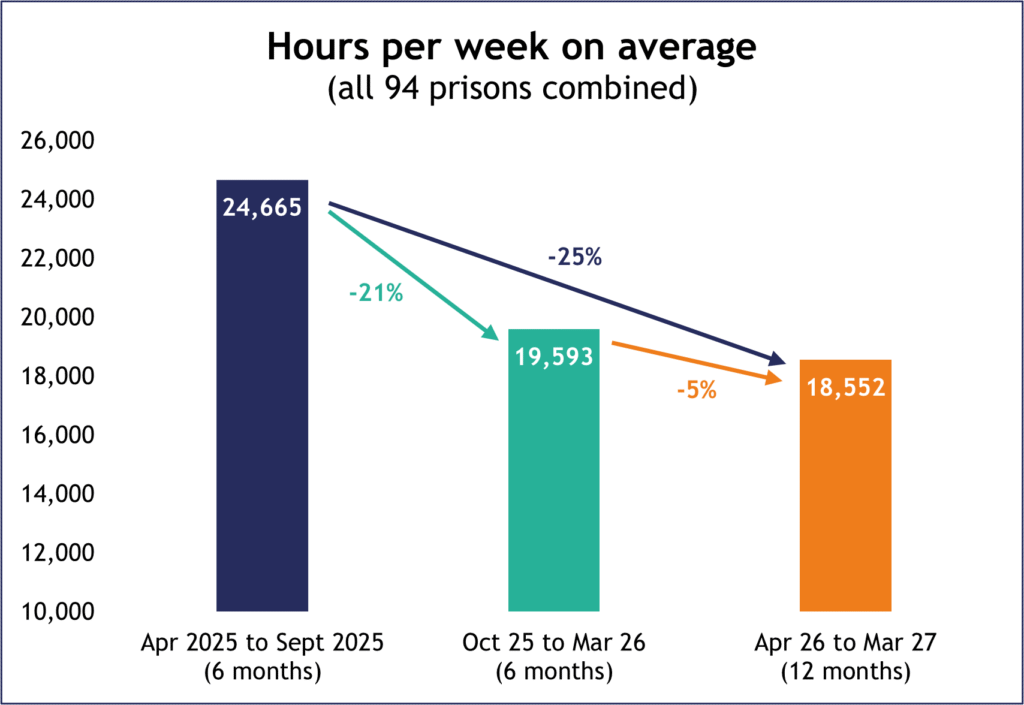
Across the 94 prisons covered by the data, there has been a two-stage cut to planned education delivery hours, with the first reduction taking effect from October 2025, and the second from April 2026.
- April 2025 to September 2025: In the final six months of the previous Core Education contracts, a total of 641,293.55 hours of education delivery was planned. That equates to 24,665.14 hours per week on average, across all 94 prisons combined.
- October 2025 to March 2026: In the first six months of the new contracts, planned hours fell to 506,615.74 hours, representing a 21% drop. That equates to 19,592.87 hours per week on average.
- April 2026 to March 2027: For the 12 months from 1 April 2026, planned delivery hours under the new contracts will fall further, with 964,700.81 hours planned for the full year. That equates to 18,551.94 hours per week on average, representing a further reduction of 5% on top of the existing 21% cut.
The total reduction in planned delivery volume for the coming year compared to the final six months of the previous contracts is 25%.
Extreme variation between prisons
The data also show extreme variation in the changes at each prison. Comparing delivery from April 2026 onwards to delivery prior to October 2025, of the 94 prisons covered by this data:
- 84 prisons have seen a decrease in their commissioned hours. The average decrease is 28%. However, six prisons – including North Sea Camp, Manchester and Preston – have lost more than 50% of their planned hours.
- Two prisons – Kirklevington Grange and Full Sutton – have seen no change to their commissioned hours.
- Only eight prisons have seen an increase in their commissioned hours, with the average increase being 13%.
HMP North Sea Camp has seen a 58% cut – the steepest of any prison – despite having an education attendance rate of 92% (the third highest of any prison).
Planned hours vs. actual delivery
The data above all relate to commissioned Core Education capacity across public prisons in England – that is, to the number of hours of education planned under each contract. The Ministry of Justice notes that this is not the same as the number of hours of education actually delivered for each period.
We are not aware of any public data setting out the difference. However, we know that the number of hours of education delivered will often be lower as classes are frequently cancelled due to shortages of teachers and officers and other disruptions.
In the youth estate, which has its own education commissioning arrangements and is a different operating environment, 43% of the hours of education planned for August to November 2025 were not delivered.
Reductions in the Prison Education Dynamic Purchasing System (DPS)
In addition to the Core Education contracts, the Prison Education Dynamic Purchasing System (DPS) is a separate budget that gives each prison flexibility to commission education services to meet local needs.
In 2022/23, the DPS stood at £14.1 million nationally. It has fallen every year since then, with the budget for 2025/26 standing at £12.0 million. This represents a reduction of 15%.
Donate to PET and help people in prison gain qualifications in the face of the cuts. You can also sign up to our email newsletter.